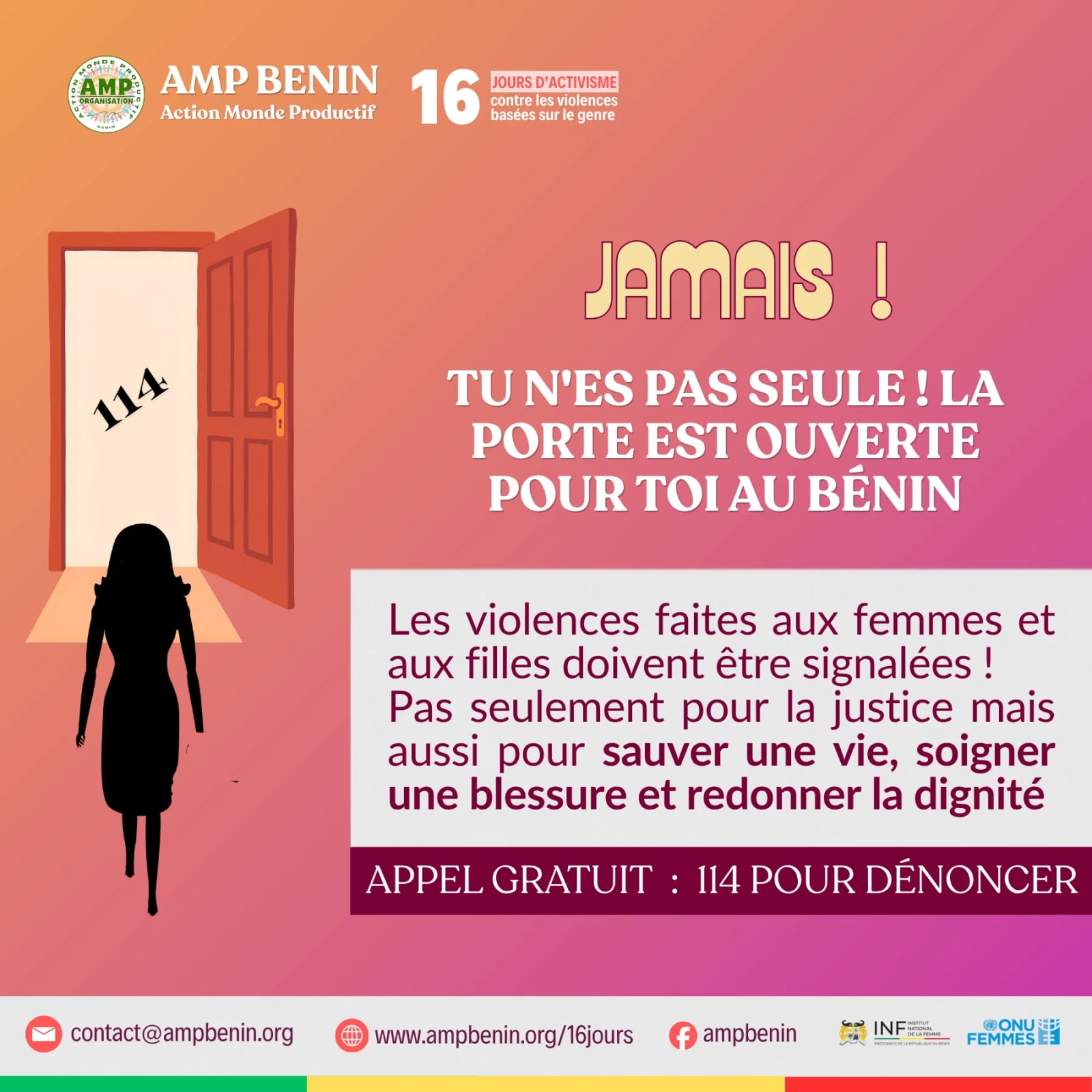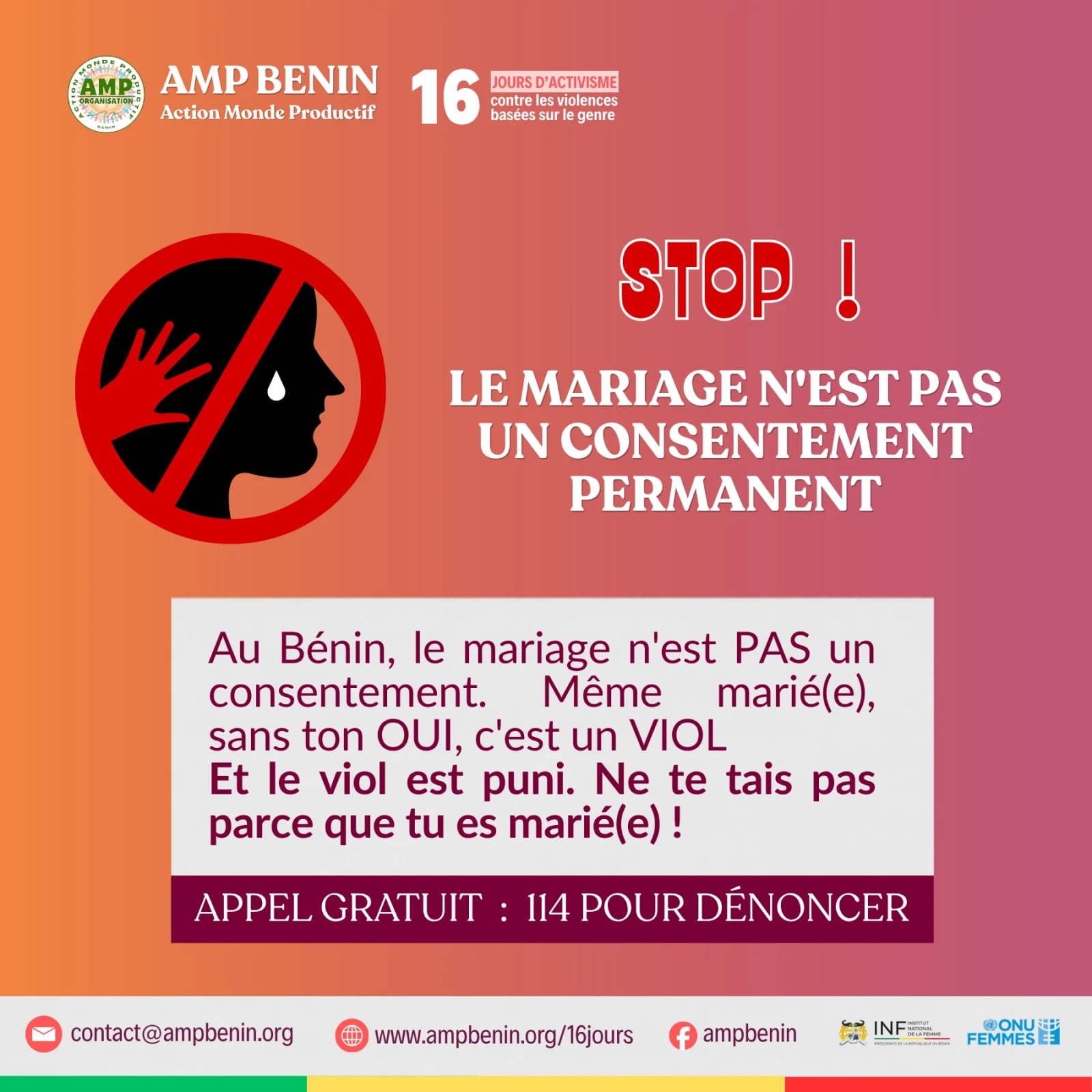
In our society, a misconception continues to trap many men and women in suffering: the belief that the act of marriage gives a permanent and unconditional right to one's spouse's body. When a sexual encounter or violence is imposed within a couple, many do not dare to speak out, thinking that the marital status erases the notion of consent.
Through the 16 Days of Activism against Gender-Based Violence (GBV) campaign, Action Monde Productif (AMP BÉNIN) reminds a fundamental truth: marriage is not permanent consent[cite: 3].
« In Benin, marriage is NOT consent. Even married, without your YES, it's RAPE. And rape is punishable. Don't stay silent because you're married! » — Official awareness message from AMP BÉNIN[cite: 3]
What Consent Really Means within a Couple
Consent is a free, clear, informed, and voluntary agreement, given without constraint, fear, blackmail, or violence. It cannot be bought with a dowry, imposed by force, or acquired for life through a contract or ceremony.
Even in a legal, customary, or religious union, each person retains the fundamental right to say « yes » or « no », at a specific moment, according to their physical, emotional, and psychological state. Ignoring a partner's refusal or coercing them under threat undermines their dignity and integrity.
Why You Should Never Stay Silent Because You're Married
Staying silent in the face of domestic violence or non-consensual sexual encounters does not protect the home: it perpetuates fear, isolation, and the repetition of abuse. Recognizing that a non-consensual act is a serious violation allows you to escape unjustified guilt.
Reporting these violations is an essential act to:
- Save a life and their safety: Put an end to an escalation of physical, psychological, or sexual violence before it becomes irreversible.
- Heal a wound: Access adapted medical and psychological support to repair often invisible suffering[cite: 3].
- Restore dignity: Remind that no one has the right to humiliate or violate another under the pretext of marriage.
Who to Ask for Free and Confidential Help in Benin?
If you are experiencing violence or imposed relationships within your couple, or if you are a witness to such a situation in Benin, dedicated structures are available to listen and guide you without judgment:
- National Institute for Women (INF): Call the 114 (green line accessible 24/7) or write directly to WhatsApp at 01 51 07 88 88 to benefit from confidential listening and support[cite: 3].
- Single Window for Social Protection (GUPS): Present in Benin's communes, GUPS (formerly called Social Promotion Centers — CPS) provide local social and psychosocial support.
- Your local Police Station: Republican Police units receive complaints, direct you to medical care, and accompany you through legal proceedings.
- AMP BÉNIN's Anti-GBV IA Coach: If you want to inform yourself or ask questions discreetly 24/7, chat with our assistant directly on our website ampbenin.org or on Messenger via @ampbenin.org.
The 3 Essential Reflexes in the Face of Domestic Violence
- Protect your immediate safety: If you feel threatened or in danger, find a safe place (with a trusted person, a professional, or a police station) and contact 114[cite: 3].
- Consult a healthcare professional: In case of physical violence or sexual assault, get examined quickly at a health center and keep useful medical records.
- Surround yourself with reliable support: Talk to a trusted person, a social worker from GUPS, or the INF listening team so you don't carry this burden alone.
Mutual Respect is the Foundation of a Dignified Life
A healthy home is based on respect, listening, and the dignity of each person. Breaking the silence around consent in marriage is defending human rights and building more just relationships in Benin.
Find all the publications and resources of the campaign on ampbenin.org/16jours or write to the AMP BÉNIN team at contact@ampbenin.org.